Journals That Sound Like You: A Quick Comparison
Are you journaling for productivity or for your mental health? We explore the dual nature of journaling and compare top apps—Notion, Day One, Obsidian, and Penso Notes—to help you find the ultimate personal sanctuary.
4/24/20265 min read

Journaling has a split personality.
If you ask ten people why they keep a journal, you will likely get two very different categories of answers. Half will tell you it’s how they organize their lives—tracking habits, managing tasks, and building a "second brain." The other half will say it’s how they survive—a safe place to vent, process grief, sketch out anxieties, and capture fleeting memories.
This represents the dual nature of journaling: Time Management versus Psychological Well-being.
The problem? Most digital note-taking apps are built for only one of these purposes. They are either sterile, corporate databases designed for maximum efficiency, or they are beautifully designed diaries that lock your most intimate, psychological data behind corporate cloud servers.
But what if your journal could do both? What if it could keep your life organized while actually capturing the messy, vibrant, multi-sensory reality of who you are?
Let’s explore the dual nature of journaling and compare the top tools on the market to see which ones actually "sound" like you.
---
### The Dual Nature of Journaling: Architect vs. Sanctuary
To understand what makes a great digital journal, we have to look at the two roles it plays in our lives.
#### 1. The Time Management Tool (The Architect)
This is the domain of the digital bullet journaler and the productivity enthusiast. The goal here is clarity and structure. You need tagging systems, calendars, to-do lists, and searchability. An "Architect" journal prevents the chaos of daily life from overwhelming you. It’s about the future—what you need to do, and where you need to go.
#### 2. The Psychological Release (The Sanctuary)
This is the emotional, sensory side of journaling. It is a space for mindfulness, mood tracking, and self-care. The goal isn't productivity; it's expression. You don't just want to write text; you want to record the sound of the rain, quickly sketch a doodle that matches your anxiety level, or drop a visual sticker to capture a vibe. A "Sanctuary" journal is about the present—how you feel right now.
When looking for a journaling app, you need a tool that can handle the rigorous demands of the Architect while providing the emotional safety and multimedia tools of the Sanctuary.
---
### Journals That Sound Like You: The Comparison
How do the biggest names in the digital journaling space stack up when we compare their productivity power against their emotional resonance and privacy? Let’s break it down.
#### 1. Notion: The Ultimate Architect
* The Vibe: A blank, infinite filing cabinet.
* Time Management: 10/10. Notion is legendary for its databases, Kanban boards, and interconnected pages. You can build a journaling system that tracks every habit, mood, and goal with mathematical precision.
* Psychological/Sensory: 3/10. Notion feels like a workplace. It is highly text-and-block focused. Recording an intimate voice memo or casually doodling feels out of place here.
* Privacy: Cloud-based. Your data lives on Notion’s servers. It is entirely unsuited for highly sensitive, private diaries.
#### 2. Day One: The Classic Digital Diary
* The Vibe: A beautiful, polished, traditional journal.
* Time Management: 6/10. It has great calendar views and tagging, but it is fundamentally a chronological diary, not a workspace or a bullet journal.
* Psychological/Sensory: 9/10. Day One excels at this. You can add photos, audio, and location data. It feels deeply personal and is built to be a time capsule of memories.
* Privacy: End-to-End Encryption is available, but it is heavily reliant on central cloud syncing (and a subscription) to keep your devices updated.
#### 3. Obsidian: The Secure Brain
* The Vibe: A hacker’s dream for linked thinking.
* Time Management: 9/10. With its massive plugin ecosystem, you can turn Obsidian into a productivity powerhouse, tracking daily notes and building vast webs of knowledge.
* Psychological/Sensory: 4/10. Because Obsidian relies entirely on plain Markdown text files, doing anything "sensory"—like sketching or embedding custom stickers and audio—requires technical workarounds. It’s highly effective, but it doesn't intuitively "sound" like you.
* Privacy: 10/10. It is completely local-first. Your files live on your device.
#### 4. Apple Journal: The Algorithmic Prompt
* The Vibe: An automated memory lane.
* Time Management: 2/10. Apple Journal lacks basic organizational tools. There are no tags, no folders, and no real ways to manage your life or productivity.
* Psychological/Sensory: 8/10. It uses on-device machine learning to prompt you based on photos you took, places you visited, or music you listened to. It’s great for effortless, sensory capturing.
* Privacy: High (tied to Apple’s ecosystem), but it is locked strictly to iOS devices.
#### 5. Penso Notes: The Private Sensory Sanctuary
* The Vibe: A secure, offline-first hybrid of an expressive diary and a structured workspace.
* Time Management: 8/10. Penso acts as a powerful "mess-free Bujo." With its custom icon categorization, rich text editor, and deep search capabilities, you can organize a chaotic mind without the overwhelming complexity of Notion.
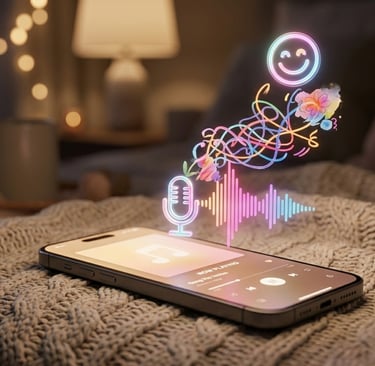
* Psychological/Sensory: 10/10. Penso introduces Sensory Snapshots. It is built with native tools to record audio memos directly into your notes, sketch emotional doodles via a built-in painter, and decorate entries with a rich visual sticker library. It allows your journal to literally sound and look like your real life.
* Privacy: 10/10. Penso offers uncompromising security. It operates as a Digital Vault secured by biometric locks. But the real magic is the Local Handshake. Penso is 100% offline-first. When you sync your phone to your laptop, it uses P2P (Peer-to-Peer) technology to "Sync without the Center." There are no corporate cloud servers standing between your devices.
---
### Why Your Journal Must Sound Like You
The biggest takeaway from this comparison is that while time management is important, a journal fails if it doesn't emotionally resonate with its user.
If you want to build emotional resilience, you need to capture more than text. You need to record the ambient 5-second soundscape of a bustling coffee shop in Paris. You need to quickly scribble a messy, chaotic red drawing when you are frustrated. You need to use visual stickers to anchor your memories.
When you look back at these Sensory Snapshots years from now, you won't just read about your life; you will re-experience it.
### The Final Deciding Factor: The Privacy Elephant in the Room
If we accept that a journal must contain your deepest psychological states, your audio recordings, and your personal photos, we run into a massive problem: Who owns that data?
Most apps on the market are cloud-dependent. The moment you hit "save," your intimate voice note or habit tracker is beamed to a server owned by a tech giant.
If you are looking for an app that bridges the gap—giving you the organizational tools of an Architect, the multimedia expression of a Sanctuary, and absolute ownership over your data—**Penso Notes** stands alone.
Because it uses a completely anonymous, local-first architecture, your thoughts are Always On, Always Ready, and completely yours. No cloud, no central servers, no snooping.
Just a digital sanctuary that finally sounds exactly like you.
***
Ready to experience the perfect balance of organization and emotional self-care? [Download Penso Notes today] and build your offline, private sanctuary.
Penso Notes
Discover seamless journaling and creative reflection today.
Connect
Support
contact@penso-notes.com
© 2025. All rights reserved.