
Paper vs. Pixel
What Neuroscience Says About Handwriting, Memory, and Building a Smarter Note-Taking System
Penso Notes
1/7/20263 min read
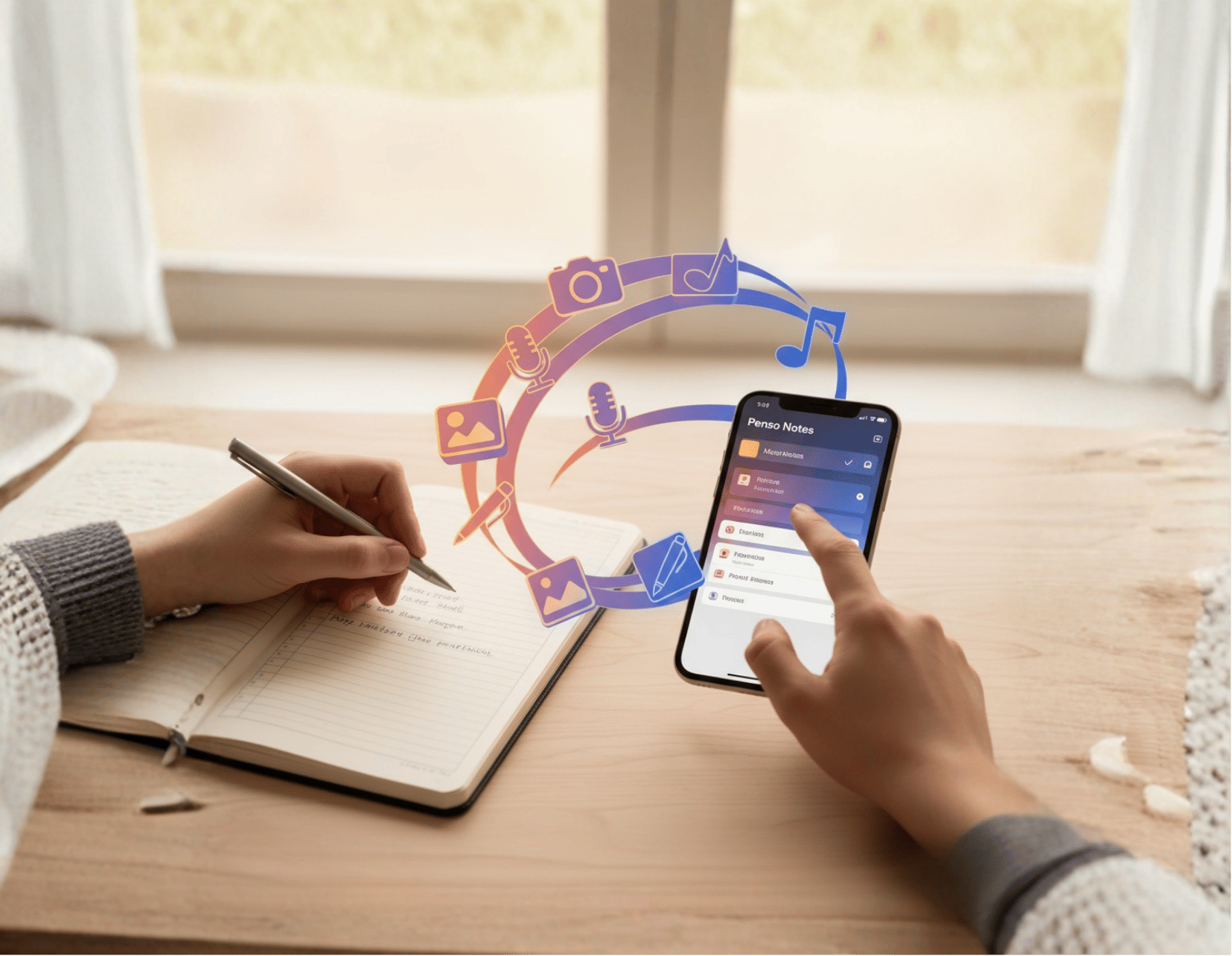
This debate is usually emotional.
Let’s make it biological.
Paper feels human.
The resistance of the page.
The scratch of the pen.
The silence.
Digital feels powerful.
Infinite storage.
Instant search.
Automatic backup.
For years, we’ve asked the same tired question:
Which one is better?
Neuroscience suggests that’s the wrong framing.
Your brain doesn’t care about nostalgia or convenience.
It cares about what kind of work you’re asking it to do.
If you are trying to learn, paper often wins.
If you are trying to organize, pixel wins.
The mistake is forcing one tool to do both.
The Brain Doesn’t Take Notes the Way We Think It Does
Most people assume note-taking is about recording information.
It isn’t.
Note-taking is about encoding.
Your brain decides what to remember based on how much effort and sensory input was involved during capture. The richer the input, the stronger the memory trace.
This is where the analog vs digital difference begins.
1. Handwriting Creates “Cognitive Velcro”
Have you ever written something down, never looked at it again, and still remembered it?
That’s not coincidence.
It’s how memory encoding works.
Research with university students shows that handwriting on paper activates more brain regions and leads to better recall than typing or tablet input.
Why?
Because handwriting is slow, physical, and imprecise.
That sounds like a disadvantage.
It isn’t.
When you write by hand, your brain processes:
The motor movement of your fingers
The pressure of the pen
The shape of each letter
The spatial location on the page
All of that creates multiple memory anchors.
Your brain doesn’t store just the information.
It stores the experience of writing it.
This is why you remember:
“I wrote that near the margin.”
“Below the heading.”
“Next to that messy diagram.”
These details act like cognitive velcro—extra hooks for memory to cling to.
Verdict:
If your goal is deep understanding or long-term retention, analog wins.
2. Why Digital Notes Feel Easier—and Stick Less
Typing is efficient.
And that’s precisely the problem.
When typing, most people transcribe rather than synthesize.
The hands move faster than the mind.
This creates what researchers call shallow processing.
The information passes through you, but it doesn’t lodge itself.
Digital note-taking often optimizes for capture, not comprehension.
This is why students with perfectly formatted digital notes sometimes remember less than those with messy handwritten ones.
The brain remembers effort.
Not aesthetics.
3. The Digital Superpower: External Memory
Where paper excels at encoding, it fails at scale.
Paper is excellent for internal memory.
It is terrible for external memory.
Modern life produces more information than any brain can hold:
Projects
Tasks
Articles
Ideas
Conversations
This is where digital tools become essential.
Digital notes offer two abilities paper never will:
Searchability
You can find a note from three years ago in seconds.
Scalability
No weight. No limit. No physical decay.
Digital tools aren’t trying to replace your memory.
They’re trying to extend it.
Verdict:
If you need to build a reliable second brain, digital is non-negotiable.
4. The Speed Paradox No One Talks About
Here’s the counterintuitive finding.
In controlled studies, people using paper completed note-taking tasks about 25% faster than those using tablets or smartphones.
Why would a slower tool be faster?
Because digital introduces decision friction.
Which app?
Which folder?
Which format?
Which font?
Every micro-choice steals attention.
Instead of thinking about the idea, you start managing the tool.
Paper doesn’t ask questions.
It just receives.
This leads to an important insight:
Digital tools only work when they disappear.
When the interface becomes the focus, thinking slows down.
5. The Real Answer: Intentional Hybrid Systems
The future isn’t analog or digital. It’s intentional.
High-functioning systems use each tool for what the brain evolved it for.
Paper for thinking
Digital for remembering
Paper for learning
Digital for retrieval
The mistake is dumping everything into one place.
The Penso Philosophy: Digital That Behaves Like Paper
Penso was designed around this neuroscience.
It’s digital, so you get:
Search
Structure
Privacy
Long-term reliability
But it behaves like paper:
Instant open
No formatting decisions
No visual clutter
No productivity theater
It’s not trying to be a dashboard.
It’s a private workshop.
A place where thoughts are captured, not performed.
Digital for the archive.
Analog for the moment of thinking.
A Simple Rule That Actually Works
You don’t need a new system.
You need clearer boundaries.
Try this today:
If something needs to be understood, write it by hand.
If something needs to be found later, store it digitally.
If something needs both, start on paper—then transfer intentionally.
This isn’t inefficiency.
It’s respect for how your brain works.
The Quiet Conclusion
The smartest note-taking system isn’t the one with the most features.
It’s the one that knows when to get out of the way.
Give your brain texture when it needs depth.
Give it structure when it needs recall.
Paper and pixel aren’t competitors.
They’re collaborators.
Use each where it thinks best.
Penso Notes
Discover seamless journaling and creative reflection today.
Connect
Support
contact@penso-notes.com
© 2025. All rights reserved.