
Your Unfinished Thoughts Are Exhausting You: Why Multitasking Indian Professionals Need Micro-Journaling
For the Indian professional whose mind never really clocks out. You're not tired because you did too much. You're tired because your brain is holding 40 unfinished thoughts with nowhere to put them. This piece breaks down the psychology of cognitive overload — and why one sentence a day might be the most underrated form of mental relief you're not using yet.
5/20/20265 min read
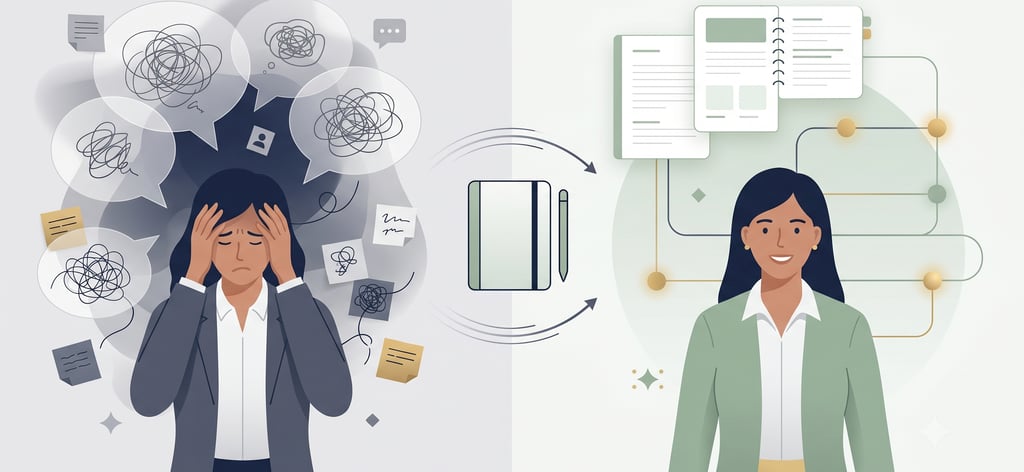

You're sitting in Bengaluru traffic, mind half-replaying the morning standup, half-drafting a reply to that passive-aggressive Slack thread. Your phone buzzes–a family WhatsApp group asking about weekend plans, a LinkedIn notification about a webinar you should attend, a mental note to reschedule the dentist. By the time you reach your desk, you've "done nothing," yet you're already depleted.
This isn't laziness. This is fragmented cognition–and it's quietly exhausting you.
Modern Indian professionals live in a state of permanent context-switching. You toggle between high-stakes work conversations and low-stakes personal obligations within seconds. You carry invisible mental tabs open across a dozen unfinished thoughts: the project update you need to send, the conversation you should've had with your manager, the idea you had on your morning walk that's now slipping away.
Your mind isn't weak. It's overloaded.
And the worst part? Most of the tools we use to "organize" ourselves–the sprawling Notes apps, the endless to-do lists, the rigid productivity planners–feel like work. They add friction instead of reducing it. They demand structure when what you need is release.
The Invisible Weight of Unfinished Mental Loops
There's a principle in psychology called the Zeigarnik Effect, named after Soviet psychologist Bluma Zeigarnik, who noticed that waiters could remember complex unpaid orders perfectly–until the bill was settled. Once completed, the memory vanished.
Our brains are wired to hold onto unfinished tasks. That incomplete thought about the client pitch? The unresolved tension from the team meeting? The fleeting creative insight you had but never captured? They don't disappear. They linger in your background cognitive processing, draining mental bandwidth you can't afford to lose.
This is why you feel tired even when you haven't "done much." Your mind has been running silent processes all day–keeping a dozen half-formed thoughts alive, waiting for closure.
In the modern Indian workplace–where Slack notifications collide with WhatsApp family chaos, where "quick syncs" multiply into meeting marathons, and where evening upskilling courses compete with personal downtime–you're not just managing tasks. You're managing cognitive noise.
And standard tools fail because they treat your mind like a work machine, not a living, breathing, multi-dimensional human trying to survive modern life.
Why Your Notes App Feels Like a Junk Drawer
Open your phone's default Notes app right now. Chances are, it's a chaotic mess: grocery lists beside work brainstorms, half-written ideas next to passwords you saved three years ago, personal reflections buried under meeting agendas.
This isn't disorganization. This is context blur–when the boundaries between different parts of your life collapse into a single, undifferentiated space.
Your brain craves segmentation. When you open a document to process work stress, your mind shouldn't be visually reminded of the groceries you forgot or the travel itinerary from last month. When you want to capture a fleeting creative thought, you shouldn't have to scroll past sterile, corporate-looking lists.
The environment shapes the thought. A cold, text-heavy interface signals "this is work." A soft, breathing digital space signals "this is reflection."
Most tools ignore this. They give you one interface for everything, expecting your mind to do the heavy lifting of creating psychological boundaries. But you're already exhausted. You don't need more mental labor. You need cognitive relief.
Enter Micro-Journaling: Fast Capture for Modern Life
Let's reframe what journaling actually is–and what it should be for you.
Micro-journaling is not:
Aesthetic diary writing with perfect prose
Long-form emotional deep dives
Rigid habit tracking that makes you feel guilty when you skip a day
Micro-journaling is:
Rapid logging of disappearing thoughts before they decay
Low-friction reflection that takes seconds, not sessions
Immediate cognitive release–closing mental loops so your brain can finally let go
It's the behavioral interface for surviving modern cognitive overload. It's what happens when you honor the fact that your mind is moving fast, context-switching constantly, and holding too much at once.
One sentence at 11 PM about how today felt. A voice memo captured in traffic about that product idea. A bulleted brain dump between meetings to externalize the chaos. That's micro-journaling.
The goal isn't perfection. The goal is closure–giving unfinished thoughts a place to land so they stop circling in your head.
Designing Your Digital Headspace: The Penso Approach
This is where most tools fail–and where intentional design matters.
What if your digital journaling space adapted to the cognitive state you're in? What if switching from "work mode" to "personal reflection mode" felt as intuitive as walking from your office into your bedroom?
This is the philosophy behind Penso Notes–a journaling ecosystem built around the idea that your mind needs rooms, not just pages.
Here's how it works:
1. The Focus Room: Your Professional Diary
High-contrast themes. Sharp, minimalist layouts. Clean typography that signals logic and execution. This is where you rapid-log your workday: meeting notes, project reflections, strategic thoughts, quick debriefs.
No distractions. No soft gradients or personal nostalgia. Just clarity.
When you open this space, your brain knows: this is where I process work, fast and focused.
2. The Sanctuary: Your Personal Journal
Soft gradients. Warm, breathing fonts. Gentle visual rhythms. This is your subconscious trigger to unwind.
Lightweight gratitude entries. Mood logging. Evening reflections on how the day felt, not just what you did. Creative musings that don't belong in the corporate world.
When you open this space, your brain exhales. This is where I'm human, not productive.
3. The Utility Closet: Frictionless Capture
Voice memos recorded in traffic. Photos of whiteboards from brainstorming sessions. Rapid custom bullets for random thoughts that don't fit anywhere yet.
No formatting pressure. No "what category is this?" paralysis. Just capture before it disappears.
This isn't about aesthetic organization. It's about reducing friction to zero so that the act of capturing a thought takes less energy than letting it evaporate.
Three Micro-Journaling Rules to Start Today
Rule 1: Lower the bar to one sentence.
You don't need to write an essay. One sentence about how today felt is enough. "Today was heavy." "I handled that meeting well." "I'm tired but okay." Close the loop. Let your brain release it.
Rule 2: Use voice when typing feels like work.
If you're mentally drained, don't force yourself to type. Hit record. Speak your thought aloud in 30 seconds. Let it land somewhere outside your head. That's enough.
Rule 3: Separate work and life–visually.
Don't let work thoughts live in the same visual space as personal reflections. Use different themes, different rooms, different cognitive signals. Your brain will thank you for the clarity.
Stop Letting Unfinished Thoughts Exhaust You
You're not failing at productivity. You're succeeding at being human in an inhumane pace of life.
The mental clutter isn't a character flaw–it's a design problem. You've been handed tools that add friction instead of reducing it, that treat your mind like a filing cabinet instead of a living, breathing entity that needs space to breathe.
Micro-journaling isn't about becoming more productive. It's about becoming less exhausted.
It's about giving your unfinished thoughts a place to land. It's about closing mental loops before they drain you. It's about creating digital rooms that honor the complexity of your inner life–not flatten it into sterile bullet points.
If your mind feels like a browser with 47 tabs open, it's time to close some windows.
Download Penso Notes and give your thoughts a place to rest. Not a productivity tool. Not a guilt machine. Just a quiet digital headspace where your fragmented attention can finally find relief.
Because you deserve mental breathing room. And your unfinished thoughts deserve closure.
Penso Notes
Discover seamless journaling and creative reflection today.
Connect
Support
contact@penso-notes.com
© 2025. All rights reserved.